
Into the Blank
History provides some inspiring stories of people who changed the world because they were willing to change direction.

After my recent guest column, “What Ben Franklin Can Teach Us About Midlife (and Life in General),” for Chip Conley’s Wisdom Well Substack, I received a flood of new subscribers to my Mind Inclined Substack. Welcome, new Mind Travelers!
With you in mind, I decided to write another column with special relevance to midlifers—but, hey, twenty- and thirty-somethings, don’t stop reading! There’s something here for you, too. All of us, age 0 to 100 and beyond, face opportunities that challenge us to adapt. We can turn away from these opportunities, believing we could never do this kind of thing or be this kind of person, or we can follow the examples of some famous historical figures and discover new parts of ourselves.
If you have ever been job hunting, you probably know this experience…
You come across a job title or a brief job description and immediately decide, “I could do this! This sounds like a perfect job for me!”
When you read the full job description, however, you start having second thoughts. “Wait, I’ve never done this kind of thing. They want me to be able to do what? Do I even want to do some of these things?”
Now imagine reading a job description that sounds like this:
Wanted: “a person perfectly skilled in botany, natural history, mineralogy, astronomy, with at the same time the necessary firmness of body & mind, habits of living in the woods & familiarity with the Indian character.”
These are the actual words of someone you know describing a role that eventually would be filled by someone else you know. Any guesses?
The author of this “job description“ was Thomas Jefferson, who needed someone to lead an expedition to explore the new territory the United States had acquired in the Louisiana Purchase. The person he “hired“ was Meriwether Lewis.
The Fiction of “Fit”
Now, this was the very early nineteenth century – long before formal job descriptions like the ones we know today, before LinkedIn and Indeed, before human resources departments. Jefferson did not post his “job description“ on the White House website and form a committee to screen applicants. He already knew Lewis, who was his personal secretary, and selected him for the job, but he also knew that Lewis did not have everything the job required. Here’s more of what he wrote about the job (in a letter to Robert Patterson):
I propose to send immediately a party of about ten men with Capt. Lewis, my secretary, at their head. If we could have got a person perfectly skilled in botany, natural history, mineralogy, astronomy, with at the same time the necessary firmness of body & mind, habits of living in the woods & familiarity with the Indian character, it would have been better. But I know of no such character who would undertake an enterprise so perilous.
OK, Lewis, you’re it.
To succeed in this endeavor, Lewis was going to have to grow, adapt, become something he wasn’t. Judging from the success of the expedition, which not only mapped an extensive portion of this new part of the country, but also documented hundreds of new species and dramatically expanded knowledge of this region, I think we can agree that Lewis passed the test.
Heading into the Blank
It wasn’t easy. It wasn’t even just hard. It was grueling, disappointing, literally sickening, and sometimes life-threatening. Over the course of the more than two years that Lewis, Clark, and the rest of their Corps of Discovery spent crossing thousands of miles of uncharted land, they endured extreme hunger, bitter cold, a treacherous mountain crossing, hailstones the size of softballs, an 18-mile portage over prickly pear cactus, and encounters with bears, fleas, and mosquitoes so thick that they got into the men’s throats. While they were busy finding their way and trying just to survive, they also kept detailed journals. (Trying to spell all the words in his accounts may have been the hardest thing that poor William Clark had to do. Then again, maybe he didn’t care all that much. The record shows that he found 27 different ways to spell Sioux.)
Before facing and overcoming any of these hardships, though, Lewis first had to make the decision to accept the job of leading this expedition. To use a modern term, he had to decide whether he was a good “fit“ for the job.
He was not a botanist, a mineralogist, or an astronomer. He wasn’t even an explorer, really. He had been a soldier, and, in that role, had survived in the wilderness. He also was capable of learning. Ultimately, for Jefferson, that was enough.
Lewis’s studies, which involved studying under some of the leading scientists of the time, served him well, but they could not prepare him for everything he was to encounter. We can try to imagine the thoughts – doubt? anxiety? outright fear? – Lewis must have experienced as he contemplated what lay ahead. It may help to have a look at one of the few maps of the land he was going to traverse.
I often use this map when I give talks about the Lewis and Clark expedition because it visually captures an important aspect of their journey. Have a look:
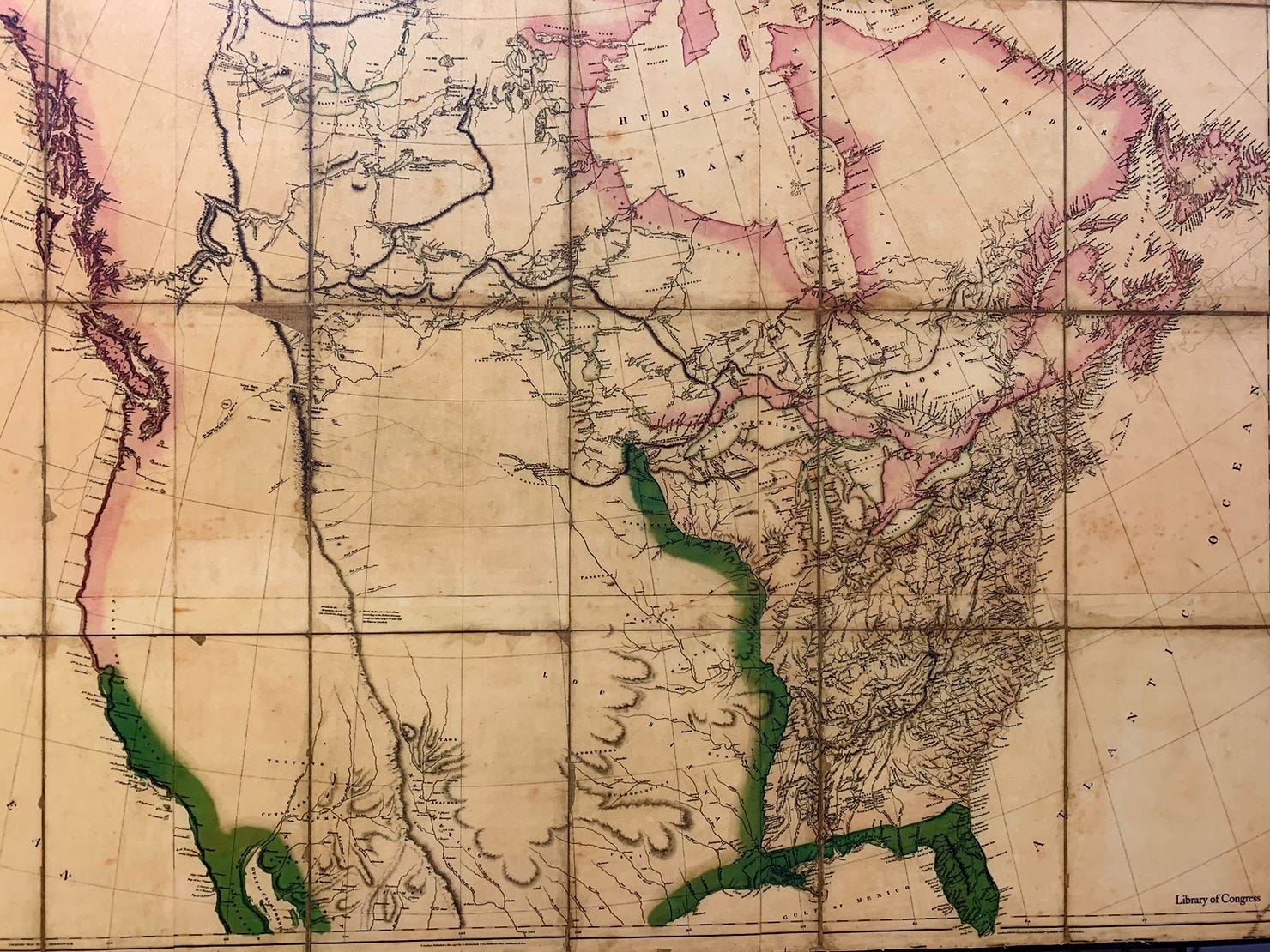
The title of one of my talks, in fact, is “Lewis, Clark, and Sacagawea: Into the Blank.” As this map by Aaron Arrowsmith shows, the Corps of Discovery would have to navigate an enormous expanse that was largely unknown to themselves and their counterparts back in the eastern United States.
Growing through the Job
Once they entered this uncharted territory, all Lewis and his fellow explorers could do was to keep going and to keep doing the best they could. A sentence they frequently used in their journals says it all: “We proceeded on.”
Thanks to their willingness to adapt, grow, and proceed on into and through this gigantic blank, the United States gained invaluable information about the new part of its territory.
Neither Lewis nor Clark was ideal for this crucial role, but they took a chance and grew into it, allowing the job itself to help make them what they were capable of becoming.
How might history be different if they had considered the job description and decided, “No, that’s not for me”?
In the more than two centuries that followed, a similar story has played out again and again. Edgar Allan Poe wrote fanciful and romantic poetry before he tried his hand at horror fiction. Harriet Tubman worked in the fields before escaping slavery and guiding hundreds of enslaved people to freedom. Samuel F. B. Morse had been working and studying as an artist when he came up with the idea for a telegraph.
These and other seemingly “unfit” prospects changed the world because they were willing to enter a blank and proceed on until they succeeded.
What’s Your Blank?
Look around you. I suspect you will see, if you open your mind’s eyes wide enough, giant blanks like the one that Lewis and Clark entered—not the literal one on the Arrowsmith map, but the metaphorical one that they entered when they took on the challenge of leading this one-of-a-kind expedition, despite their lack of experience.
Many years ago, when I was teaching English at a university in North Carolina, my department chair said something that has stuck with me. It went something like this: “Never teach a class for the first time.” He was joking, of course. As the more famous saying goes, “There’s a first time for everything.” That first time can be scary because we don’t have the experience that brings knowledge, skills, and confidence, but we can’t start with a second time. If we never do something for the first time, we will never do it at all.
Let’s face it, though: some blanks are more intimidating than others. It’s one thing to teach a class or make a sales call for the first time. It’s another thing to change careers, start a business, or launch a new personal endeavor. The fear of failure looms large because, well, we don’t know exactly what we’re doing because we haven’t done this thing before.
In addition to running Mind Inclined (a new endeavor for me!) and serving as the chancellor of a college campus (once upon a time, also something new to me), I serve on the board of Nexel, an organization that serves universities with midlife transition programs—that is, programs serving adults poised to pursue new endeavors, often around retirement age. (I can’t believe it, but I’m at that stage of my own life!)
Retirement is a logical time to be thinking about new endeavors, new blanks to fill. Nowadays, many Americans in their 60s are perfectly capable of contributing, but are interested in the opportunity to do something different from what they have been doing in their careers. As the line goes, they are not merely retiring from something, but retiring to something else.
I encourage all of you (and myself) to find inspiration in the example of Lewis and Clark. Their example of amassing the courage and confidence to head into the blank can help you—and indeed all of us at any age—plunge into our own blanks. After all, we never know what we can do until we do it.
Thank you, Grayson. I’m glad it resonated with you. You were right to take the plunge! That willingness to plunge into the blank will serve you well.
This is a very inspiring article, and one that I believe really speaks to, as you said, anyone of any age or point in their life. I connected with it through my own connection to the intimidation of failure and even the unknown. My time in college has put me in a lot of those positions, the possibility of failure, the many roles and opportunities I've worked hard towards and the unexpected ones as well. Recently I was convinced I should run for a local elected office, that was a terrifying thought, what if I'd fail, am I the right person for this job. But with encouragement and a free meal, I was convinced. I was nervous and afraid of the paperwork to get all of it moving the process, but we went through the motions filled out the papers needed, went to file. It was the experience of doing and taking that step that helped raise doubt in that uncertainty. We discovered we had the wrong maps and I didn't qualify for that district, so perhaps it was for the best it didn't work out, but now I know in a few years if I pursue that path, I know I can at least get through early paperwork. I guess long story short, no matter where we are in life, the things that mean the most for us, that we know can affect the lives of others, when we care the most, we also become the most intimidated by failure. In reality we have to give it a try, for if we never try, we won't know if we can succeed. No one is ever perfect at anything as you mentioned in your article. It's the courage to push through and to try anyway that counts the most, no matter how old we are.