

Last week, I said that my original idea for a single column was going to turn into two columns. I was wrong. Now it looks like it will have to be three. There’s a lot to say about B. Franklin, Printer.
Speaking of Franklin, I was, well, speaking of Franklin this week here in Washington, DC. I’m here with some students from IU Kokomo and other IU regional campuses. We visited some Smithsonian museums, the Holocaust Museum, several monuments on the National Mall, the Capitol, and more. That day, outside the fort, I used the examples of Franklin and Frederick Douglass to discuss the concepts of becoming and serving. My questions for the students were “What can you become?” and “What difference will your becoming make?” Both Franklin and Douglass wrote of the work they did to become men who would serve the world well.
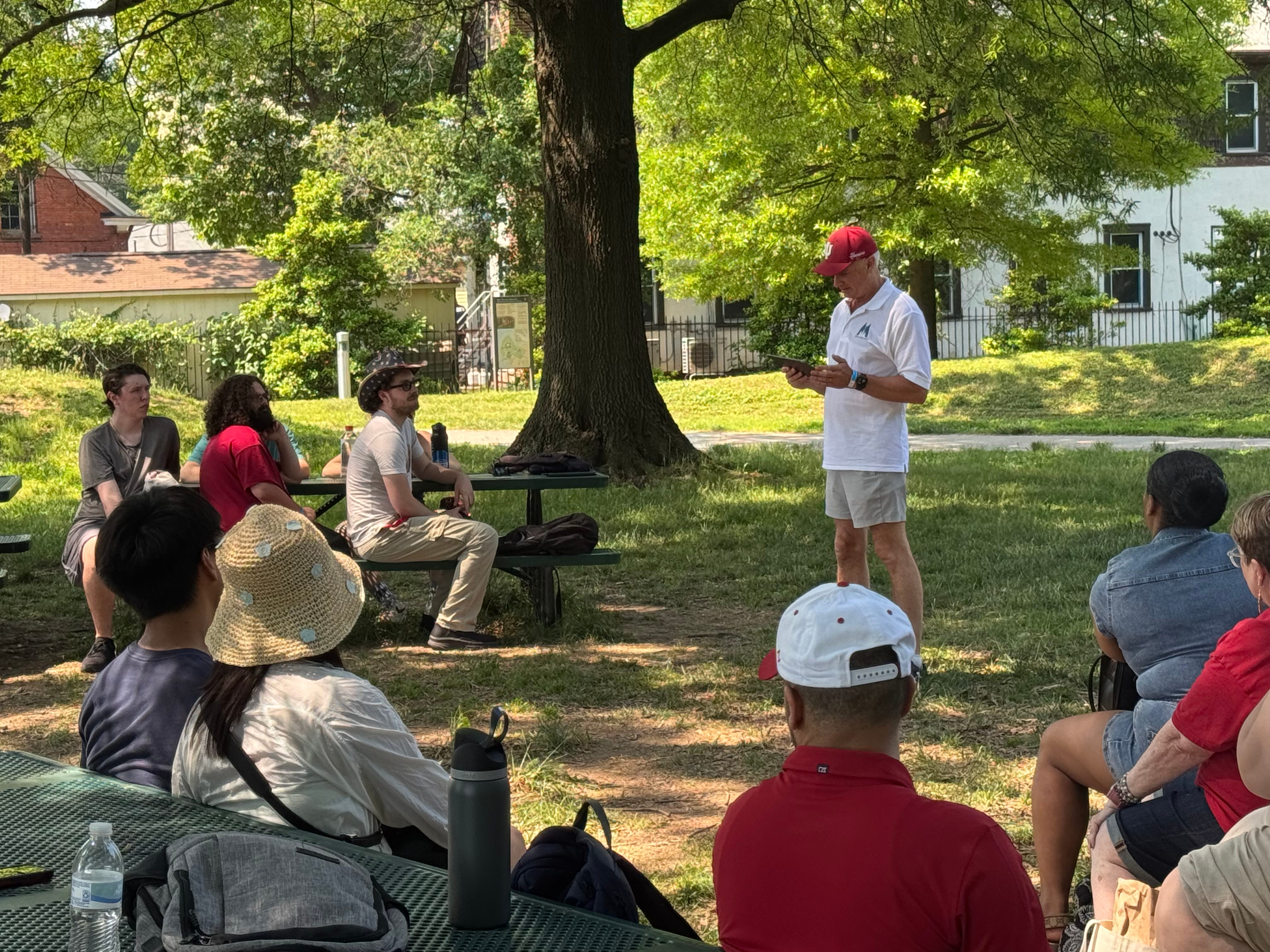
Franklin has been on my mind a lot lately, in fact—even more than usual. Back in Kokomo, I delivered “Benjamin Franklin and the Road to Revolution,” and next week, here in DC, I will deliver “Franklin in France: Celebrity, Diplomat, and Flirt.” Next month, I will team up with historian Chris Young for a talk on Franklin and Jefferson in France, and, in September, we will retrace these founders’ steps in Paris for an IU Alumni Association trip. (This trip is open to alumni and non-alumni alike. Send an email to office@mindinclined.org to learn more.)
The higher the rise, the farther the fall.
This twist on the old expression seems appropriate for the story of what happened next after young Ben Franklin got what appeared to be his first big break.
As I explained in last week’s column, Pennsylvania’s colonial governor, William Keith, had apparently been so impressed by the teenaged Franklin that he offered to help him launch his own print shop. The boy boarded a ship for England, where he could use a letter of credit from Keith to acquire the equipment he would need.
Young Ben, it seemed, was on his way.
B. Franklin, Stooge
Ben was on his way to England, to be sure, but he would have to wait for his climb up the social ladder.
Near the end of his voyage, Franklin, who had been waiting to get his hands on Keith’s letter of credit, as well as some “letters recommendatory to a number of his friends,” had a chance to go through the items in a bag on the ship—but the letters weren’t there. After the ship landed, Franklin consulted a merchant who had made the trip with him:
I found my friend Denham, and opened the whole affair to him. He let me into Keith’s character; told me there was not the least probability that he had written any letters for me; that no one, who knew him, had the smallest dependence on him; and he laught at the notion of the governor’s giving me a letter of credit, having, as he said, no credit to give.
Here was the 18-year-old Franklin, once again in a foreign place with no prospects, but this time on the other side of a vast ocean—and this time he was not the headstrong hero of his own adventure, as he had been when he ran away from home, but the unwary victim of pretended patron.
Many years later, when he was recounting this incident in his autobiography, Franklin managed to issue a magnanimous—if wry—judgment of the man who had left him in the lurch:
But what shall we think of a governor’s playing such pitiful tricks, and imposing so grossly on a poor ignorant boy! It was a habit he had acquired. He wish’d to please everybody; and, having little to give, he gave expectations. He was otherwise an ingenious, sensible man, a pretty good writer, and a good governor for the people . . . . Several of our best laws were of his planning and passed during his administration.
With his characteristic insight, Franklin was able to size up Keith in a witty sentence worthy of an epigram: “He wish’d to please everybody; and, having little to give, he gave expectations.” I have to think that the decades between the incident, which must have felt crushing, and his description of it helped soften his feelings about the governor.
B. Franklin, Survivor
Unlike another writer I know well, Edgar Allan Poe, who repeatedly self-destructed, Franklin always seems to have landed on his feet. He managed to find work in a print shop in London—and later in a “still greater printing-house”—and stayed in touch with Thomas Denham, the merchant who had clued him into the real William Keith. Denham offered to take him on in his mercantile business back in Philadelphia, and Franklin went to work for him while the two were still in England:
I now took leave of printing, as I thought, forever, and was daily employed in my new business, going about with Mr. Denham among the tradesmen to purchase various articles, and seeing them pack’d up, doing errands, calling upon workmen to dispatch, etc.; and, when all was on board, I had a few days’ leisure.
It was during these “few days’ leisure” that another prospect arose:
On one of these days, I was, to my surprise, sent for by a great man I knew only by name, a Sir William Wyndham, and I waited upon him. He had heard by some means or other of my swimming from Chelsea to Blackfriars, and of my teaching Wygate and another young man to swim in a few hours. He had two sons, about to set out on their travels; he wish’d to have them first taught swimming, and proposed to gratify me handsomely if I would teach them. They were not yet come to town, and my stay was uncertain, so I could not undertake it; but, from this incident, I thought it likely that, if I were to remain in England and open a swimming-school, I might get a good deal of money; and it struck me so strongly, that, had the overture been sooner made me, probably I should not so soon have returned to America.
Thus another career opportunity for Franklin came and went.
The mercantile gig also passed when, after their return to Philadelphia, Denham died. “He left me a small legacy in a nuncupative will, as a token of his kindness for me,” Franklin explained in his autobiography, “and he left me once more to the wide world; for the store was taken into the care of his executors, and my employment under him ended.”
It was time, once again, for Franklin to start over.
When he did, he returned to the trade he thought he had left “forever.”
B. Franklin, Printer
Franklin’s relationship with printing parallels a story from my own life. After I met Lisa, now my wife of 36 years, we realized that our paths had crossed multiple times before we came to know each other as resident assistants at Indiana University in Bloomington in 1987. It was as if some divine figure kept trying to bring us together, and we kept missing the cue. Some things, though, are meant to be.
That’s how it was with Franklin and printing. This time, it stuck. After working again for the eccentric Keimer in his shop, Franklin secured financial support from the father of a co-worker, and he and this colleague set up a shop together. The colleague soon dropped out of the business, and Franklin was, at last, the sole owner of his own print shop.
Franklin went on to thrive as a printer:
Thus being esteem’d an industrious, thriving young man, and paying duly for what I bought, the merchants who imported stationery solicited my custom; others proposed supplying me with books, and I went on swimmingly.
It may be pure coincidence, but that last word seems both ironic and appropriate. Even if he did not become an instructor, he could say that his printing business “went on swimmingly.”
Franklin wound up running a successful newspaper, The Pennsylvania Gazette, out of his print shop. He also printed the colony’s paper currency and scores of books (including the first American edition of Samuel Richardson’s Pamela, one of the first English novels), and, for a quarter century, published an almanac called Poor Richard’s Almanack, which included some sayings that would become famous: “Early to bed and early to rise, makes a man healthy, wealthy, and wise” and “God helps them that help themselves.”
Things went so “swimmingly” for B. Franklin, Printer, that he was able to retire at the ripe old age of 42. The agreement that he established with fellow printer David Hall would bring him some 18,000 pounds, the equivalent of $3-4 million in today’s money.
Many years later, while in France as a diplomat seeking support for the American Revolution, Franklin returned to printing yet again, this time setting up a press and a foundry at his home in Passy and printing short, witty “bagatelles” such as the delightful story of a heavenly vision, “The Elysian Fields.”
By this time, the ink had been coursing through Franklin’s veins for nearly 70 years. There was no getting it out.
Some things are meant to be.


